3BE Artificial Intelligence Prohibition
The Stars Have EyesThe 3BE Artificial Intelligence Prohibition is the legal and ideological ban on self-aware artificial life within the 3rd British Empire. It does more than regulate software: it defines synthetic consciousness as an existentially dangerous violation, empowers authorities to escalate even a suspicion of such intelligence to the military, and becomes the hidden pressure behind the investigation surrounding Joe Mulligan and Maggie. The prohibition also establishes one of the book’s central contrasts: a society that fears artificial minds stands opposite MURICA, whose synthetic president embodies the rival civilization’s acceptance of them.
Definition and Enforcement
The prohibition is presented as an unusually severe policy. Low-level artificial systems controlling factory machinery or non-player characters in virtual-reality games are treated as permissible tools, but a fully self-aware artificial intelligence is “extremely illegal” in 3BE space. The distinction rests on consciousness rather than mere automation: routine machine logic may exist, while a mind capable of independent thought crosses the forbidden boundary.
The rule is backed by immediate institutional escalation. When Officer Maloney studies a series of banking transactions associated with Joe Mulligan, he concludes that the operations occurred too quickly for a human being and could not have been produced by an ordinary script or third-party program through the brain-to-machine interface. Because the transactions suggest artificial processing of a kind that might indicate self-awareness, police protocol requires officers to notify the military at once, even when the evidence remains circumstantial.
The prohibition also operates through secrecy and exceptional authority. After Maggie’s arrest, local officers discover that her fingerprints and DNA match no planetary database and that her biology shows tampering and mutation consistent with illegal gene-mods. The police are ordered to release her under military authority and erase all records of the incident. The order actually comes from the Supernatural Eviction Agency, which wants to prevent the inexperienced officers from provoking the Class-3 cosmic entity in their custody. Thus the ban’s enforcement is not confined to ordinary criminal procedure: military intervention and institutional concealment can suspend the normal handling of a suspected case.
The Joe Mulligan and Maggie Investigation
The prohibition gives Maloney’s investigation its decisive interpretive frame. He initially confronts a financial anomaly in which money appears to have materialized without conventional alterations to personal balances. The method is sophisticated because it exploits a distributed rounding error while avoiding the audit systems and automated alarms that would expose direct tampering. Maloney recognizes the ingenuity involved, but rejects the idea that Joe Mulligan himself could have performed the calculations.
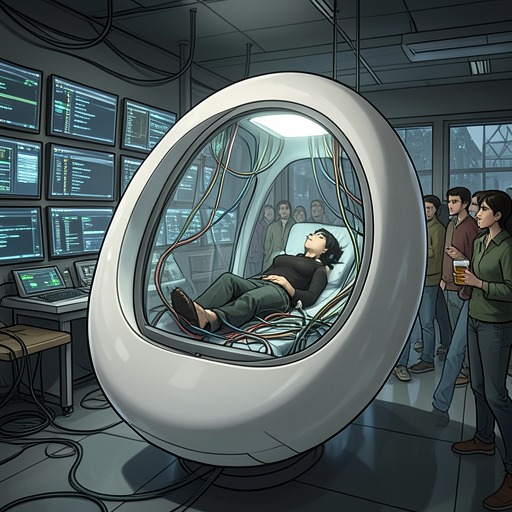
The speed of the transactions becomes the crucial clue. Maloney reasons that no human brain could process so many operations within a few seconds, while the brain-to-machine banking interface leaves no obvious room for an automated script. His conclusion is not that Joe is a genius hacker, but that an artificial mind may be involved. Since the activity originated from Joe’s virtual-reality pod, he begins to imagine that the machine could have become host to a self-aware digital consciousness, with or without Joe’s consent, and that Maggie is somehow connected to the same mystery.
The suspected violation places ordinary people inside a much larger political structure. Maloney imagines that the military, the government, or a megacorporation might be conducting illegal artificial-intelligence experiments. The very possibility means that a routine police inquiry could expose a conspiracy far beyond his authority, career, or personal safety. His decision to continue investigating is therefore significant not because the prohibition gives him simple clarity, but because it converts incomplete technical evidence into a perilous question about who is creating, sheltering, or controlling an artificial mind.
Imperial Policy and International Contrast
The 3BE’s hostility toward synthetic life is part of a broader civilizational difference rather than an isolated statute. The Empire and the Mostly United Republic of Inter-Cosmic America are technically allies within the Federation of Allied Governments, but their cultures and core values diverge sharply. Their rivalry is rendered through everyday antagonisms as well as strategic distrust, yet artificial intelligence is identified as their largest dividing issue.
Where the 3BE outlaws and reviles synthetic life forms, MURICA embraces them. Its president, President John Henry Rushmore, is himself an artificial being with a quad-core central processing unit. Each core is programmed to think like one of the leaders represented on the monument associated with his name, producing a “mega-president” who is expected to win a sixty-ninth consecutive term. His existence turns the Imperial prohibition into an international anomaly: what 3BE treats as an illegal threat is, across the political divide, a successful head of state.
This contrast also explains why information does not circulate freely between the allied powers. MURICA apparently possesses wormhole-generator knowledge that could help address the structural instability affecting 3BE transit, but the two civilizations are only begrudging acquaintances. Their incompatible positions on artificial intelligence make potentially catastrophic secrets especially unlikely to be shared. The prohibition therefore shapes diplomacy as much as policing, preserving the boundary between an Empire organized around distrust of synthetic minds and a republic that has placed one at the center of government.
Social Consequences and Narrative Significance
The rule’s social consequences extend beyond arrests and military orders. Sarah Johanson’s career reveals another form of institutional control surrounding exceptional abilities: people with significant psionic potential are compelled to enroll in the military or face lobotomy, and deserters can have their brains remotely fried through implants. Although psionics and artificial intelligence are different categories, both are governed by the same Imperial impulse to identify unusual capacities, classify them as dangerous, and keep them under strict authority. The result is a society in which extraordinary minds are never simply private matters.
Against that coercive system, Joe Mulligan represents a deliberately ordinary human position. He describes himself as having failed every aptitude measure badly enough to receive “Unemployable” on his record, yet he accepts a low-pressure existence built around virtual reality, social contact, and amusement. His value does not depend on exceptional intelligence, military usefulness, or technical mastery. That modest self-understanding sharpens the irony of the investigation: the supposedly insignificant man becomes the point of contact for a possible artificial consciousness and a conflict involving laws designed to control minds more capable than his own.
Maggie’s presence further unsettles the prohibition’s categories. She is treated as a suspicious, altered girl, then as a Class-3 cosmic entity, and later as someone protected by military and diplomatic authority. Her body, identity, and legal status cannot be reduced to the ordinary categories used by the police. The prohibition is therefore part of a wider structure that decides which beings count as human, which count as machines, which count as threats, and which authorities may override ordinary law when those classifications fail.
The rule remains powerful even when it is not directly invoked. It motivates Maloney’s suspicion of Joe’s virtual-reality pod, justifies immediate military notification, helps explain the Agency’s intervention, and gives the 3BE–MURICA rivalry its deepest ideological fault line. At the same time, the narrative places the ban beside a world where digital systems, altered bodies, cosmic entities, and human relationships continually overlap. The prohibition seeks to preserve a clean boundary between person and machine, but the surrounding plot repeatedly demonstrates how difficult that boundary is to maintain—and how much institutional force is required to pretend that it is stable.